
By Sergiy Moskalets, Inva Store
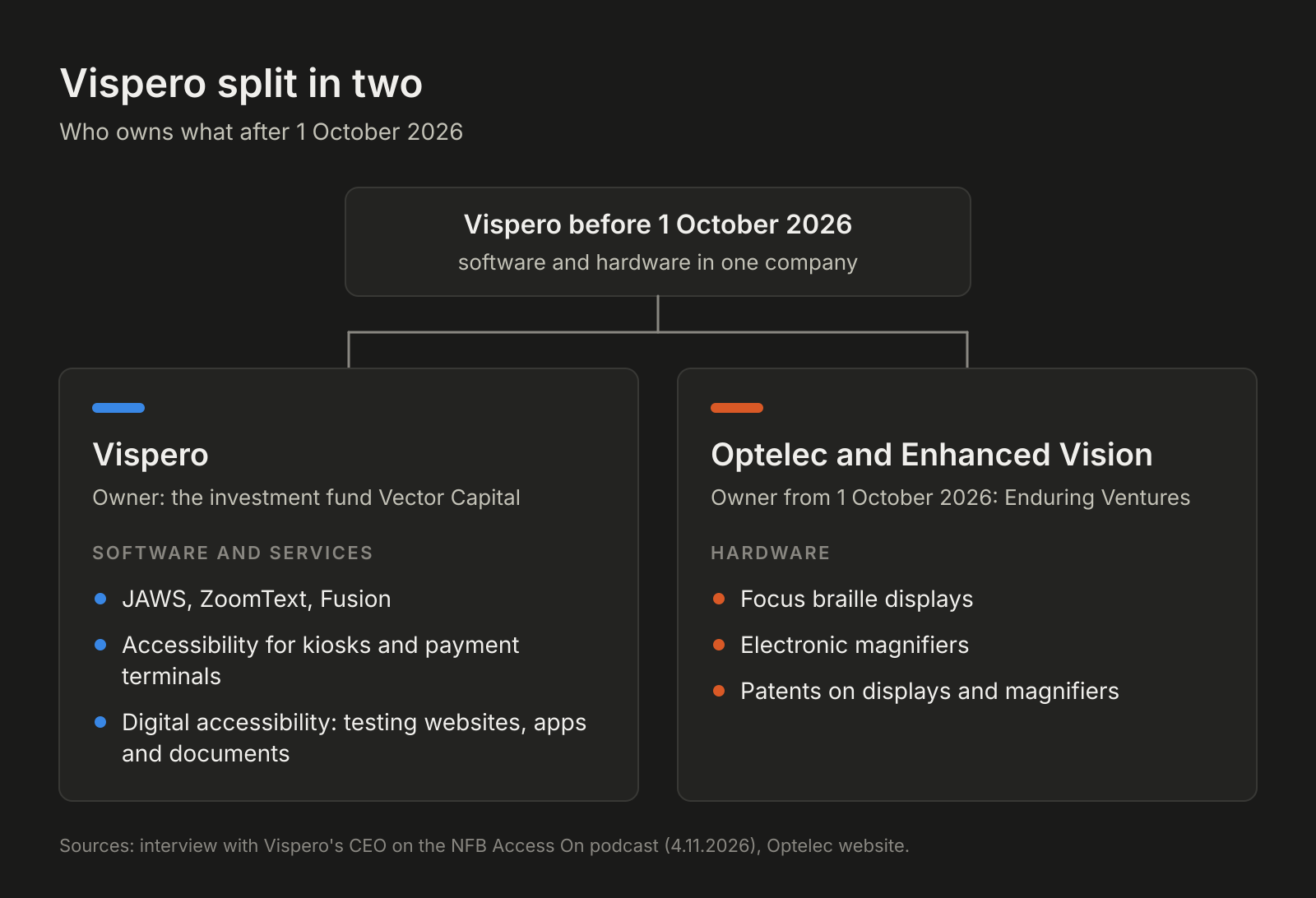
On 1 October 2026 something happened in the market for assistive technology for blind and visually impaired people that was easy to miss. No press release, no big announcements. Vispero – the company behind JAWS, ZoomText and Fusion – simply stopped making braille displays and electronic magnifiers. Its hardware business passed to Enduring Ventures, a holding company in San Francisco. Most people only learned about it from an interview with Vispero's new chief executive, published a month after the deal.
For some, the news came as a surprise. But if you look closely at the events of the past year and a half, it becomes clear: the sale was prepared long in advance, and it follows a very understandable economic logic.
Denmark is affected too. Hjælpemiddelbasen, the Danish assistive technology database, today lists, among others, the Focus 14 and Focus 40 braille displays and electronic magnifiers and CCTVs from the Ruby and Topaz series – all from the part of Vispero that now has a new owner. Even so, as far as I can see, the deal has not yet been covered in Denmark.
Inva Store does not sell the Vispero, Optelec and Enhanced Vision products described here. This article is the author's own assessment, based on public sources.
A quiet sale
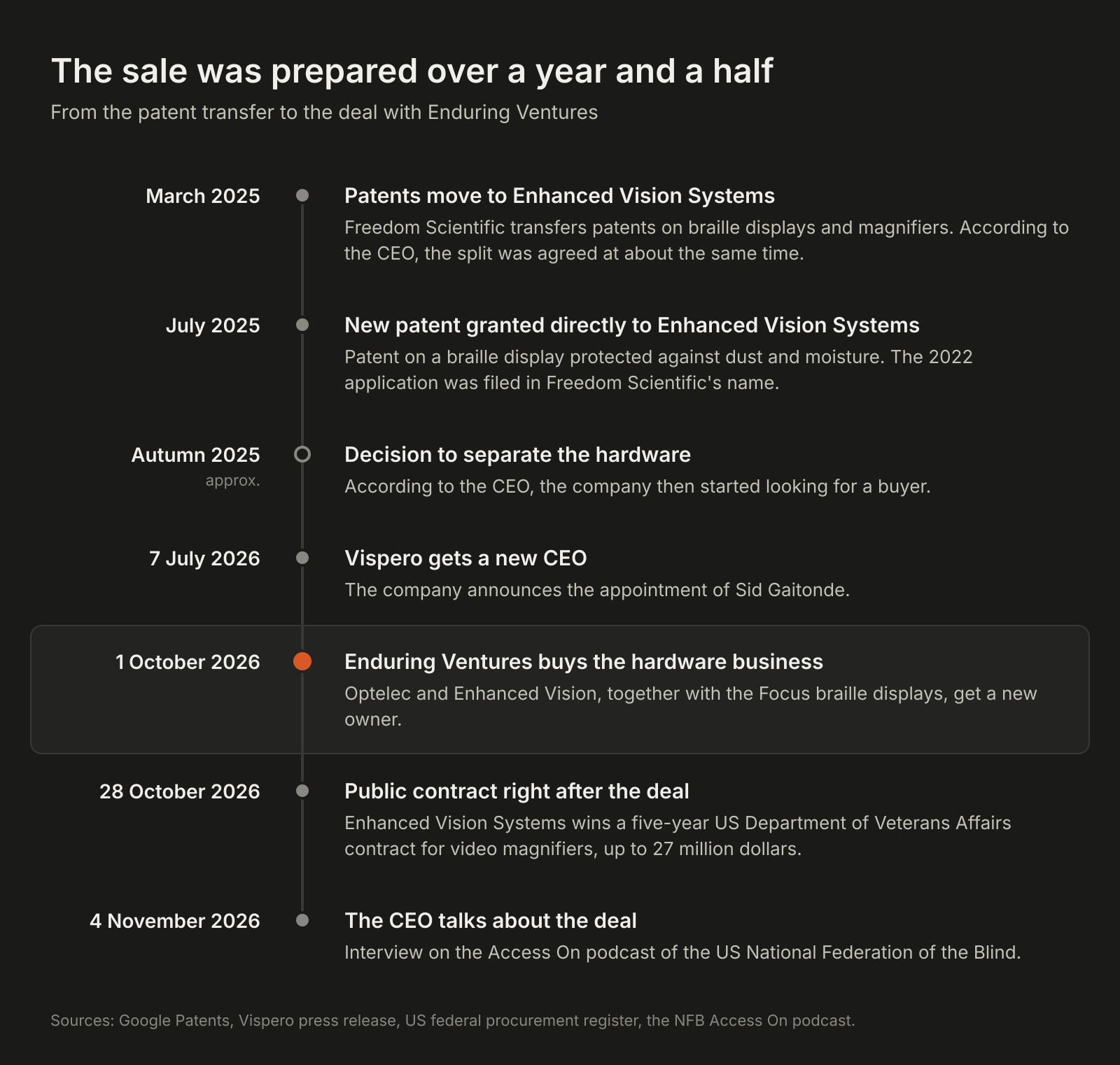
The deal was described by Sid Gaitonde, who has led Vispero since the summer. The conversation took place in an anniversary edition, the 100th episode of the Access On podcast from the US National Federation of the Blind (NFB), released on 4 November. According to Gaitonde, about a year and a half ago the company agcane that software and hardware would be better off living separately, and about a year ago it decided to separate the hardware and started looking for the best buyer. That buyer was Enduring Ventures.
Optelec's websites confirm it: "Since October 2026, Optelec Netherlands and Enhanced Vision have been part of Enduring Ventures." The Focus braille displays went with them, even though the CEO did not name a single brand and spoke only of braille displays and magnifiers. Back in May, Optelec Nederland described how the Focus 5-14, 5-40, 640 and 5-80 displays are assembled, checked twice and repaired in Barendrecht in the Netherlands. In other words, Focus is made today by exactly the part of the group that now has a new owner.
A year and a half of preparation
What is more interesting is that the transfer began long before the deal. In spring 2025 Fcaneom Scientific – the Vispero brand under which Focus, Topaz, Ruby and Onyx are sold – transferred its patents to Enhanced Vision Systems. The transfer took effect on 3 March and was recorded by the US patent office on 3 April 2025. They include patents on desktop and handheld magnifiers, on a braille display and on a braille cell. And a new patent on a braille display protected against dust and moisture was granted in July 2025 directly to Enhanced Vision Systems.
The date matches exactly the year and a half Gaitonde talks about. The hardware rights were first gathered in one company, and then that company was sold along with them. That is not how you react to a sudden attractive offer – that is how you prepare a sale.
What the CEO admits – and what he leaves out
Gaitonde explains the decision in the language of strategy. Software, especially with the arrival of artificial intelligence, needs very specific investments. And about hardware he said plainly: "Hardware needs more innovation and a ground up approach." If the company had not split, he says, it would have diluted its focus. Today about 70 per cent of Vispero's engineers work on JAWS, ZoomText and Fusion.
In essence, the CEO admits that Vispero's braille displays and magnifiers needed a renewal that the company itself did not intend to invest in. In my view, it was precisely this need that made Vispero look for a buyer.
Gaitonde did not say a word about money. But I am convinced that behind the "focus on engineering" lies, above all, economics – the kind anyone who sells assistive technology knows well.
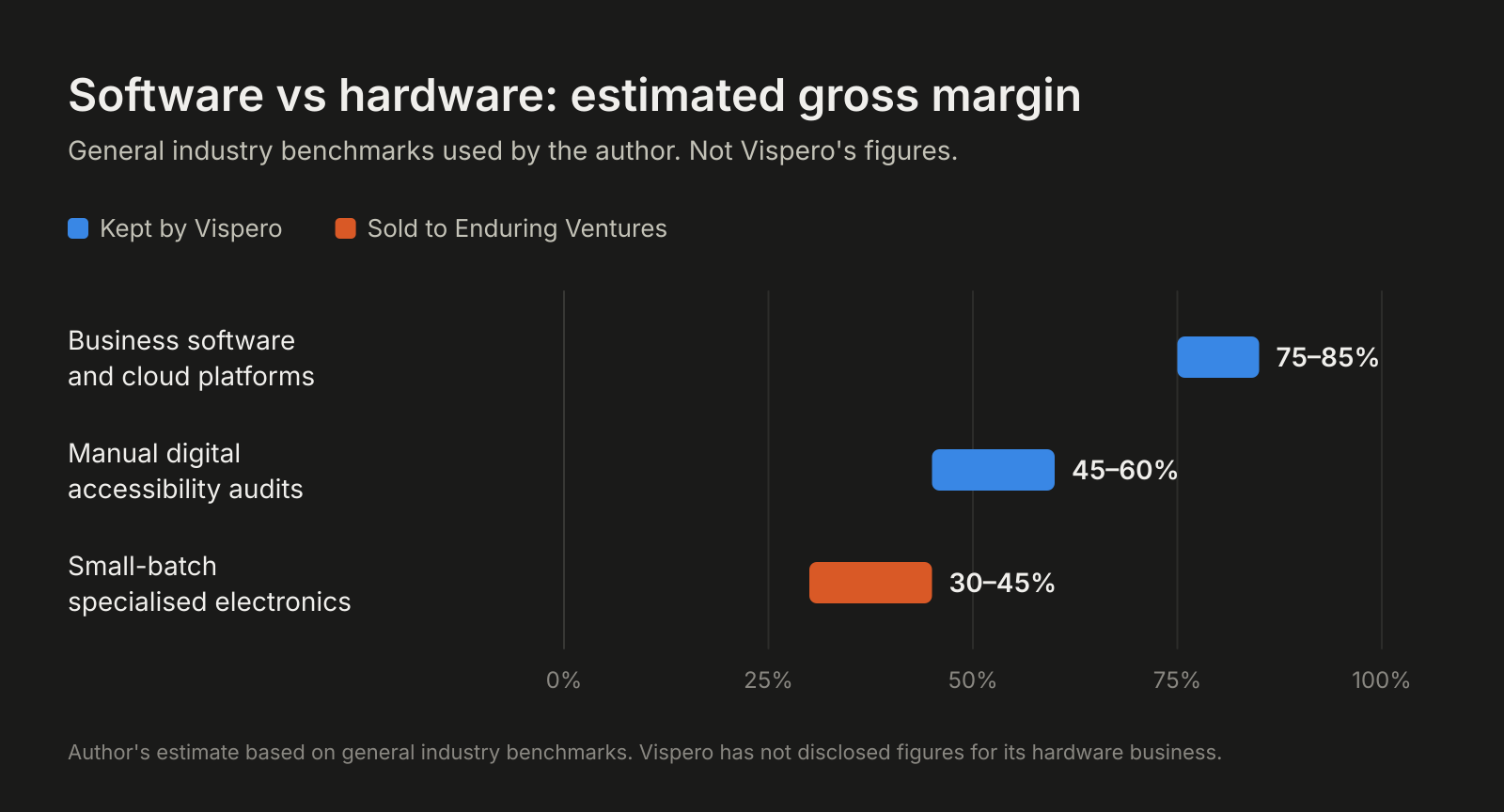
A copy of a program or an activation key costs almost nothing. That is why, according to general industry estimates, the gross margin on business software is 75–85 per cent, while in small-batch production of specialised electronics it is 30–45 per cent. Every braille display means expensive piezoelectric cells, assembly in small batches, certification, stock, warranty repairs and a distributor discount that is typically 20–35 per cent of the retail price. Hardware brought Vispero a certain profit, but it is much harder to make money on than software.
On top of that, the market for devices for blind and visually impaired people is narrow and rests largely on public rehabilitation programmes and social funds. Small volumes rule out economies of scale. These limits apply to every maker, including the main competitor, HumanWare, majority-owned since 2013 by the Essilor group, now EssilorLuxottica. But in my view, over time the Focus displays began to fall behind devices from HumanWare and other competitors, and sales rested above all on public contracts already in place. Tellingly, four weeks after the deal Enhanced Vision Systems won a five-year contract from the US Department of Veterans Affairs for video magnifiers for home use, with a ceiling of 27 million dollars. Public money remains the backbone of this business. We know the same pattern in Denmark: the vast majority of aids for blind and visually impaired people are paid for by the municipalities, and for pupils and students by the state through SPS, the special educational support scheme.
Vispero is not the first
The history of braille displays is a history of mergers, sales and bankruptcies. In 2003 Germany's BAUM bought its competitor Frank Audiodata, and Audiodata's products later quietly disappeared from the market. In 2005 the Dutch company Tieman, one of the main suppliers of braille cells, renamed itself Optelec and bought the display business of its main competitor, ALVA. America's Telesensory sold its PowerBraille display line to Blazie, which in 2000 became part of Fcaneom Scientific. Later, Optelec and Fcaneom Scientific ended up together in Vispero – and now that line is changing hands again.
The German chain ended more sadly. BAUM Retec, which once also made braille displays for HumanWare, went bankrupt in autumn 2017, and around 100 people lost their jobs. Its successor VisioBraille went bankrupt in June 2025 – after Metec, which made braille modules, stopped production at the end of 2024 and went into liquidation.
In my view, this is a telling pattern: braille display businesses either go bankrupt, close down, or are handed over or sold. Profitable businesses are sold too, but then the deal is loudly announced and the price is something to boast about. Here we see bankruptcies, quiet sales and takeovers by competitors instead.
The investor's logic
It is worth remembering who owns Vispero. It is the investment fund Vector Capital. For a fund, combining subscription software and small-batch device manufacturing in one company is an obvious imbalance. The price was not disclosed, but I assume the hardware was sold for considerably less than a software business with the same revenue would have fetched.
For comparison: in 2020 the fund Nordic Capital bought 70 per cent of Siteimprove, a Danish company founded in 2003 and headquartered in Copenhagen, which makes software for checking websites, including for accessibility. The deal was valued at about 500 million euros, which analysts put at around ten times the company's annual revenue. Nobody pays that kind of money for a device maker. Without the hardware, Vispero becomes simpler, easier to scale and more attractive to future investors.
The bet on digital accessibility
There is one more reason that gets less attention. Besides JAWS, ZoomText and Fusion, Vispero has kept accessibility for kiosks and payment terminals, as well as services that test websites, apps and documents for accessibility – the former TPGi brand. And in my view, that market is far more attractive to the owner than hardware.
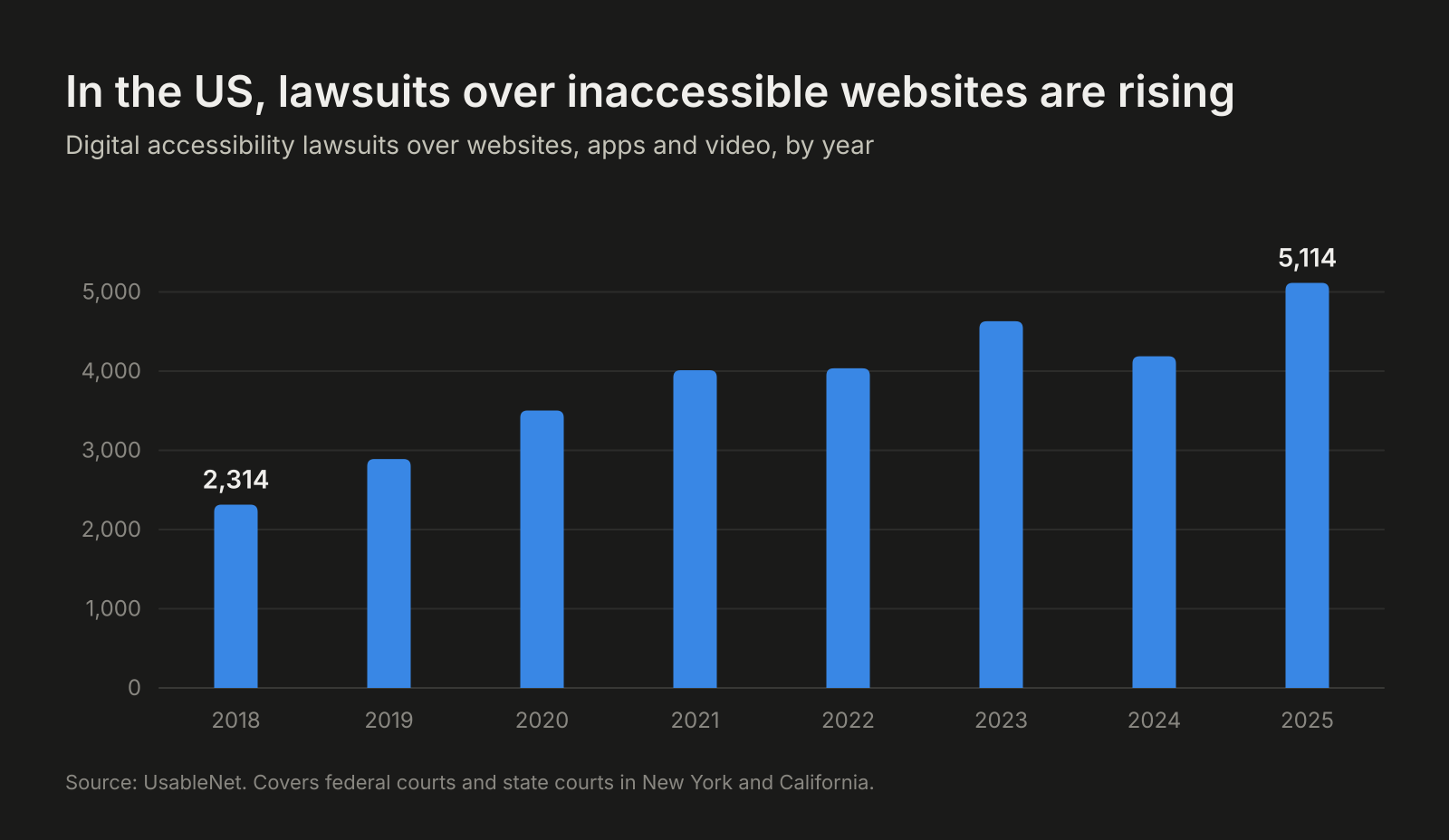
A braille display is bought for one person, often out of a social budget. Accessibility testing, by contrast, is ordered by banks, retail chains, transport operators, tech companies and public authorities. In the US the courts push them: according to UsableNet, 5,114 digital accessibility lawsuits were filed in 2025, and federal website lawsuits alone numbered 3,117, according to the law firm Seyfarth Shaw. Public procurement there requires conformance reports. In the EU, the Accessibility Act has applied since 28 June 2025 – in Denmark through the Act on accessibility requirements for products and services. Level Access, which works only on digital accessibility, became in 2024 the first company in this market to pass 100 million dollars in annual subscription revenue. Margins on cloud testing platforms here match those of software, and on manual audits they are 45–60 per cent.
And here Vispero holds a trump card – JAWS. It is not a monopoly: in WebAIM's 2026 survey, 69.2 per cent of participants use JAWS and 59.3 per cent the free NVDA, and in 2024 NVDA was even more often the primary screen reader in Europe, Asia and Africa. But in many companies and public institutions JAWS is still the standard, and a company that develops it itself has a clear advantage in accessibility audits. So in my view the owner made a simple choice: it kept the programs and services that sell to thousands of companies without stock, shipping and warranty repairs, and handed hardware production to someone willing to invest in it.
What does it mean in Denmark?
Gaitonde promises that Vispero will work closely with the business it sold, and that the results will show within a year. NFB President Mark Riccobono said in the same conversation that the federation looks forward to meeting the management of the hardware business once it is in place. So at the beginning of November the new team had not yet been formed.
For users, institutions and dealers of Optelec, Enhanced Vision and Focus, a transition period is beginning. The brands carry on, but it is not yet entirely clear whom to talk to about development, prices and service. If the new owner really invests in renewing the hardware, new devices may appear within a year or two. If not, the gap to competitors will only grow.
In Denmark, municipalities, assistive technology centres and educational institutions with Focus displays or Ruby and Topaz magnifiers in use would do well to ask their supplier how service, spare parts and warranty will be handled under the new owner.
The broader conclusion, in my view, is that assistive technology is increasingly splitting into two worlds. On one side, specialised device manufacturing, which needs narrow engineering focus and patient capital. On the other, digital accessibility, which by its own rules hardly differs from ordinary business software. Vispero has made its choice.
Responsible for the content: Sergiy Moskalets, Inva Store – working with assistive technology and IT for blind and visually impaired people since 1999. Read more about us.